
Principals & Theories Used in the Application
Principals
PhotoPosition
History
Help
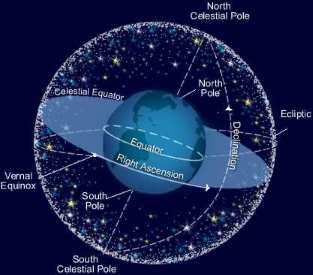
| Stellar Hemisphere In broad principals and considering the equipment available to the amateur (and perhaps many professional) astronomers, apart from near Earth objects in our solar system, 99.9..99% of astronomical objects are so distant their movement can be considered irrelevant, even though they may actually be moving very quickly. The only reason we even know any of them move at all is because of the work done by astro-physicists using very sensitive and expensive equipment, which often doesn't even operate in the visible spectrum that the layman is restricted to. All the changes we observe are due to the movement of bodies in our solar system (near-Earth objects), such as the sun, moon and planets (comets and asteroids). So most astronomy applications consider the universe made up of stars positioned on a static black sphere (the celestial sphere) of extremely large radius, defined by their RA/DEC co-ordinates. The solar system objects move within this space along their observed trajectories. This application assumes the same and as it doesn't display any near Earth objects, places the Earth at the centre of the sphere. Based on these 'assumptions' the views shown only need to consider the position of the observer on the Earth's surface and the motion of the Earth vs. the background celestial sphere. This determines the RA/DEC co-ordinates immediately above our heads. From my visit to the London Planetarium as a young teenager, long before the modern digital CGI era, they used very similar models of the universe. |
||
| Whereas the observer's location is a simple 3D geometrical problem the latter is a little more sohisticated. Luckily for me I had studied this a few years ago for some development I was doing for my safari web-site while trying to estimate the time of day early film photos were taken based on the position of the sun. I originally assumed that the transit of the sun was very simple with sunrise and sunset being positioned symmetrically either side of noon. The results I was getting were eroneous and also supported by published sun and moon tables. Studies led to an understanding that the movement of the Earth is highly complexed and can be predicted using the 'equation of time' - please follow the link for more details. My earlier work and the javscripts developed were easily incorporated in to this application. So now the stellar hemisphere can be plotted relatively easily for any practical time at any point on the Earth's surface. Co-ordinates The most popular co-ordinate system in astronomy is the RA/DEC system, which defines any position on the celestial sphere. RA = right ascension and is similar to Longitude, although it is measured in hours from 0 to 24. The hours represent the time before the star will be directly overhead at the Vernal Equinox, when the Sun's passage cuts the Equator from North to South (c. 20th March each year). DEC = declination is measured in degrees and is similar to Latitude. |
 |
|
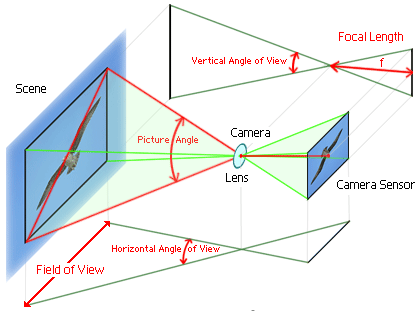 |
Photo Image Sizes Calculation of the image size of an object (see Object Details pages) also comes from my safari web-site work. Today's digital cameras embed a lot of meta data in the JPG image which can be read and used to good effect. Most provide the focal length of the camera and some the pixel density, which together with the number of pixels in the image can provide the physical chip dimensions. This can be used with the focal length to calculate the camera's field of view - usually expressed in degrees. Where the pixel density isn't provided, as in the case of the Nikon Coolpix cameras then the camera's specification sheet needs to be studied to determine the chip size. Often this is expressed as a standard image sensor (such as 1/2.3" in the case of the Nikon), which an internet search will provide the chip dimensions. Occasionally cameras also provide an equivalent focal length to a 35mm camera which could be used to determine the field of view - if they were accurate, but disappointingly my experience shows they are not. Most stellar tables, including those used for the Messier and Caldwell objects also include the object's dimensions, expressed as arcminutes (1 arcminute = 1/60th degree). It is then a simple calculation to determine the object's size in pixels. Incidentally, this is included to advise whether it is worth trying to photograph the object at all. |
|
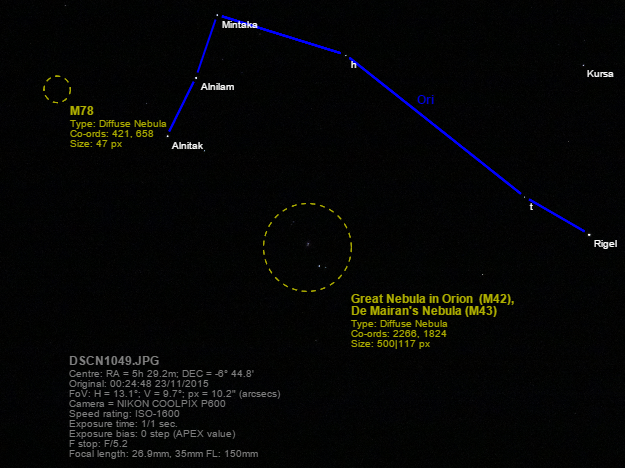
Photo Position A simple utility to 'calibrate' a photograph - determine the direction it is pointing. This version requires the user to define two points within the photograph with respect of their RA/DEC co-ordinates. Thereafter, as the Celestial sphere projection mimics the real life view, the location of any point in the photograph is a simple scale and rotate transformation. All points of interest within the photo's field of view are marked based on the stellar database. |
 |
|