
History Leading to Development of the Application
Principals
PhotoPosition
History
Help
| Inkling of an Idea In Jan. 2014 while on the beach leg of our annual safari we'd often take a drink out on the beach looking for shooting stars. Che Shale is somewhat remote with very little light polution, other than from distant towns on the horizon along the beach. Consequently, the stars were literally brilliant and unlike the UK the Milky Way was clearly visible. It occurred to me that astronomy could be my long term hobby taking over from safaris when we were too old and decrepit to enjoy. The idea grew and within a week of returning home I had run up a cost/benefit spreadsheet and ordered the best telescope I could get for the money I was willing to spend on a whim! |
|||
| Early Photography Attempts While preparing this page I reviewed some of my early photographic attempts and this showed I was a little keener than I recalled, as I obviously took advantage of the clear winter nights and endured the cold (I remember wrapping up warm in gloves and woolly hat) to capture some early photographs while waiting for the telescope to be delivered. Although obviously not the best photos taken, they were encouraging as they show photographs are at least feasible with relatively good cameras and optics and experience would fine tune the settings for better performance. |
|||
|
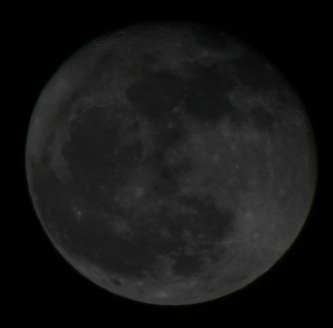
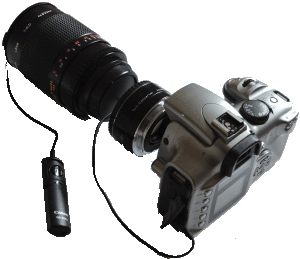
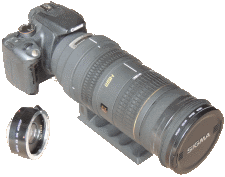
The moon is an obvious subject for any newbie astronomy photographer. This photo was taken using an old Canon EOS 300D camera and a fixed 500mm mirror lens (without the x2 converter or remote button shown), mounted on a tripod. Camera settings were: Aperture = F/8; Exposure = 1/640"; ISO-1600; bias = +2 step. The photo is a little dark - probably due to the mirror lens and a little fuzzy. |
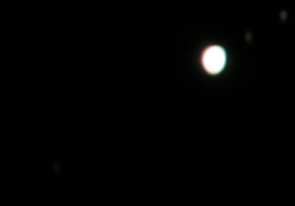
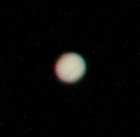
The only other object available at the time that I thought maybe worth photographing was Jupiter. These photos were taken using the slightly higher resolution Canon EOS 350D camera with a x2 converter and the 50-500mm Sigma lens, again mounted on a tripod. Image 1 - Background image Camera settings were: FL=834mm; Aperture = F/5.6; Exposure = 0.8"; ISO-400; bias = +0 step. Although Jupiter is over-exposed, this photo manages to capture 3 of its moons. Image 2 - Bottom right image Camera settings were: FL=1000mm; Aperture = F/5.6; Exposure = 1/50"; ISO-1600; bias = +0 step. In this photo Jupiter is a little fuzzy, but there are hints of its' coloured bands, running diagonally from the top right. |
|
| Telescopic Views I had a call at work one morning to say a package had arrived, but 'was I expecting it to be so big'. On getting home I found it came up to my chest! The rest of the evening was spent setting it up, when it dawned on me I wasn't going to be able to take this on holiday to Kenya, as I originally hoped. Taking further advantage of the clear skies in February I tried the telescope out on the moon and Jupiter. I have yet to try aligning the EQ2 mount with North, as the back garden faces South and I can't see the pole star through the house. So most long observations need adjustments for both RA and DEC to take into account the Earth's rotation. With a x180 zoom adjustments are required every 10-15 secs or so and can become tedious. |
|||
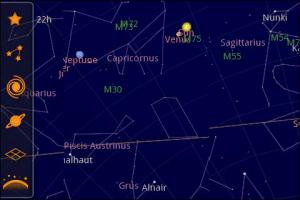
| After a little time it was apparent that if I was going to get the best from the telescope with the vagaries of UK weather I would have to plan the sessions better than simply setting up the telescope every time there was a clear night, as I could barely identify suitable objects before the cold drove me back inside. Even applications such as Google's Skymap, used with a tablet didn't really help, as it simply showed the sky above our position at that time, but not what was worthwhile viewing or viewable through a telescope, let alone what may be photographed. This is where the idea for 'MCTracker' came from. Further research showed that other than serving a useful reference points the constellations and bright stars were not going to be very fruitful and the tests I had already conducted showed that our planets were rarely in view and simply looking at the moon would get boring very quickly. After a little digging I came across the Messier Catalogue and realised that as well as being interesting celestial objects many of them would be within my observational limits, which isn't surprising as the technology available to Messier in the 1760s was similar to my own. A little further digging showed Sir Patrick Moore had extended this catalogue, known as the Caldwell Catalogue to include further items, but primarily to cover the Southern hemisphere. |
 |
||
| Development As with many new tasks the development of the application wasn't as easy as it sounds. As well as researching the principals and theories a range of other challenges ensued:
|
|||
 |
Further Observation Sessions Through the year while struggling with the development of MTracker and to keep my interest progressing I undertook some further observations. But these continued, at least initially to focus on the moon and planets as they came into view on clear nights. A combination of telescope & photographic observations were used. One conclusion of these sessions was that the Sigma 50-500 lens was almost impossible to use on portable tripods and wouldn't retain the zoom when used at higher declinations, as its weight withdrew the lens! As I couldn't take the telescope on holiday and the fixed focal length of the mirror lens limited potential targets I began to consider Alison's Nikon Coolpix P510 bridge camera. I realised this would lead to squabbles as its' settings would differ significantly between wildlife safari and astronomy shots and I decided it would be better to have my own bridge camera. As a consequence the Canon EOS 350D camera and Sigma 50-500 lens were traded in and the money invested in a Nikon Coolpix P600 camera - a later version of Alison's. It was chosen because it provided the best overall performance for the money at the time and familiarity with the Nikon Coolpix family was a bonus. |
||
| Further Developments | |||
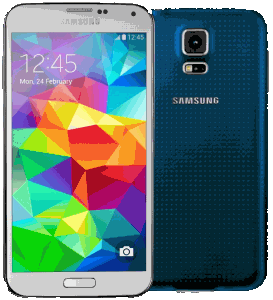
| Towards the end of the year the PC version of MCTracker had been developed and my mind was beginning to think of our next Kenya safari. Having bought the Nikon camera (and done some tests on wildlife photography at NSPB's Fowlmere reserve) I needed to migrate the application to my Ainol Numy AX1 phablet. I have now bought a Samsung Galaxy S5 that provides: a high resolution screen (1980x1080); all sensors to allow Skymap to work; Miracast connection to a SmartTV; extended memory (via a 128GB micro SD card); uses Opera to overcome Android's 'sandbox' limitations and allow local HTML pages to be displayed. MCTracker needed a little tweaking to maximise the performance on the tablet, but that was easily fixed with a little testing. So we were then ready for our next safari and looking forward to some excellent nighttime observations at the beach. Unfortunately, the weather was poor with a lot more cloud cover than usual. I found myself getting up c. 03:00 to see if the skies were clear. Overall the results were frustrating. |
 |
||
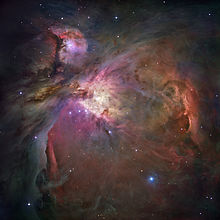 |
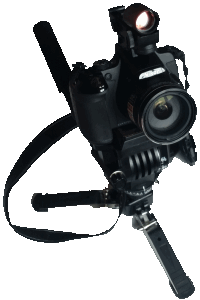
I did however identify another need. The Nikon's view finder was difficult to use for star spotting, especially when zooming in to a darkened area of the sky, such as the Great Nebula in Orion, one of the objects I targetted. I had two ideas to fix this:
|
||
| Publishing MCTracker | |||
| MCTracker was always intended as a personal application and did exactly what I wanted. When my brother in-law told me he was about to undertake an astronomy degree as a mature student he expressed an interest in seeing it. That required developing a few refinements:
|
 |
||